
Extracting Profits and Gains: How to Minimise Tax When Taking Money Out of Your Company
Building a successful business requires years of grit and strategic execution. Yet, many business owners focus entirely on creating wealth inside their company while overlooking a critical final challenge: how to extract that wealth into their personal hands.
Whether you are planning to retire, restructure, sell assets, or wind down operations, extracting cash and profits is rarely as simple as making a bank transfer. Without careful planning, standard distributions can trigger unexpected top-up income tax, expose you to loan penalties, or forfeit valuable tax concessions.
With proactive structuring, Australian tax law offers powerful pathways to extract company wealth tax-effectively. Here are six key areas every director and business owner should evaluate.
1. Unlocking Tax-Free Capital Gains (The Archer Bros. Principle)
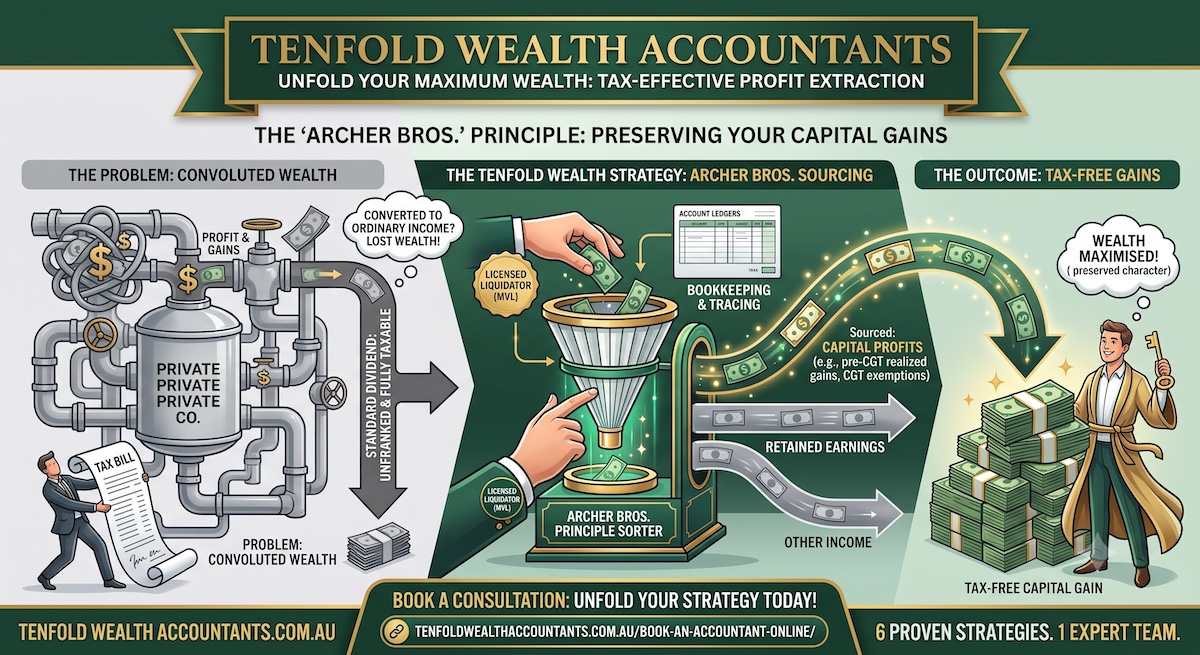
When a company sells an asset for a capital gain, that profit enters the business accounts. If you pay that gain out as a standard dividend, the ATO treats it as ordinary taxable income, taxing you at personal marginal rates (less franking credits). This effectively destroys the tax-advantaged capital nature of the gain.
However, during a formal winding-up process led by a liquidator, the Archer Bros. principle comes into play. This principle allows liquidators to stream distributions from specific capital reserves to shareholders. By attributing distributions to tax-free capital gains (such as pre-CGT gains or CGT exemptions), funds flow to shareholders as tax-free capital distributions rather than fully taxable dividends.
2. Managing Division 7A Loan Traps
It is common for directors and shareholders to draw money or take informal loans from their business. Under Division 7A, if these drawings are not fully repaid or placed under a compliant written loan agreement (with benchmark interest rates and minimum yearly repayments) before the tax return due date, the consequences are severe.
The ATO will treat the outstanding balance as an unfranked dividend, resulting in a sudden, heavy personal tax bill without franking credits. Before winding up a business or distributing final assets, all director loan balances must be audited and managed to avoid these penalties.
3. Preserving Tax-Advantaged Grants and Income
Companies often receive tax-free government relief grants or tax-exempt income streams. While these funds enter the company tax-free, they do not automatically retain that status when paid out to shareholders.
If swept up in routine dividend distributions, they are recharacterised as ordinary income. Preserving the tax-free nature of these grants requires specific distribution mechanisms—such as strategic capital reductions or structured liquidations—to ensure the benefits reach your personal account intact.
4. Resolving Unpaid Trust Distributions (UPEs)
Many family business structures feature a discretionary trust distributing profits to a corporate beneficiary (a "bucket company") to cap the tax rate at 25% or 30%. Over time, these distributions accumulate on paper as Unpaid Present Entitlements (UPEs).
If you plan to restructure or liquidate the corporate beneficiary, these UPEs represent a significant tax trap. Under ATO guidance (including TD 2022/11), releasing or forgiving these unpaid amounts without a clear strategy can trigger commercial debt forgiveness rules or convert the balance into an immediate Division 7A loan.
5. Maximising Small Business CGT Concessions
When selling business assets, the Small Business Capital Gains Tax (CGT) Concessions offer some of Australia's most generous tax relief.
Eligible entities (meeting tests like the $6 million net asset threshold or $2 million turnover) can access pathways such as the 15-year exemption or the $500,000 retirement exemption. Crucially, provisions like Section 152-125 allow these exempt capital gains to be distributed out of the company to CGT concession stakeholders completely tax-free or paid straight into superannuation.
6. Voluntary Deregistration vs. Formal Liquidation
A frequent mistake business owners make when closing down is choosing simple voluntary deregistration with ASIC to save costs. While cheaper initially, voluntary deregistration lacks the statutory powers of a licensed liquidator. Without formal liquidation, distributions made prior to deregistration are typically treated as ordinary dividends rather than capital distributions, forfeiting strategies like Archer Bros. and driving up your tax bill.
The Bottom Line: Extracting wealth from a company is a multi-step financial process where order of operations matters. Executing a payout without professional guidance can lock in tax liabilities that cannot be reversed.
Secure Your Wealth with Proactive Tax Strategy
Every company balance sheet has a unique history of retained earnings, franking credits, loan accounts, and asset reserves. Navigating profit extraction requires a tailored roadmap designed specifically for your corporate structure.
If you are planning an exit, selling business assets, or clearing historic director loans, let the team at Tenfold Wealth Accountants protect your hard-earned wealth.
Book a Tax Strategy Consultation