
Buying Property in an SMSF: How the Bare Trust & LRBA Structure Really Works
The definitive Australian tax and legal guide to acquiring real estate through a Self-Managed Super Fund using Limited Recourse Borrowing Arrangements.
⚡ Executive Summary (TL;DR)
- The Golden Rule of Cash Flow: All rental income goes directly into the primary SMSF bank account. The Bare Trust is a passive entity and never holds cash.
- Legal Structure: Under a Limited Recourse Borrowing Arrangement (LRBA), a Bare Trust holds the legal title, while your SMSF holds 100% beneficial ownership.
- Tax Benefits: Net rental income inside super is taxed at a maximum of 15% (dropping to 0% in the retirement pension phase).
- Commercial Advantage: Business owners can buy their business premises in an SMSF and pay market-rate rent back to their own super fund as a tax-deductible expense.
1. What Is an SMSF Limited Recourse Borrowing Arrangement (LRBA)?
Under Australian superannuation law, Self-Managed Super Funds (SMSFs) are generally prohibited from borrowing money. However, Section 67A of the Superannuation Industry (Supervision) Act 1993 (SISA) provides a strictly regulated exception known as a Limited Recourse Borrowing Arrangement (LRBA).
An LRBA allows an SMSF to take out a mortgage to acquire real estate. The defining benefit of an LRBA is asset protection: if your super fund defaults on the property loan, the lender's security is strictly limited to that single property asset. The bank cannot touch any other assets inside your super fund (such as cash reserves, share portfolios, or other properties).
2. SMSF Trustee vs. Bare Trust: Who Does What?
To comply with Australian borrowing rules, an SMSF cannot hold legal title to a property while an active mortgage exists. Instead, you must establish a secondary entity called a Bare Trust (also known as a Custodian Trust).
Understanding the distinct legal separation between these two entities is essential for maintaining ATO compliance:
| Feature & Responsibility | Primary SMSF Trustee | Bare Trust (Custodian) |
|---|---|---|
| Primary Function | Active Beneficial Owner & Cash Hub | Passive Legal Title Holder |
| Title Deed Name | Holds 100% Beneficial Ownership | Holds Official Legal Title |
| Bank Account | YES (Receives all rent & pays loan) | NO (Must not hold cash) |
| Collects Rent | YES (100% paid directly to SMSF) | NO |
| Pays Expenses & Debt | YES (Mortgage, rates, insurance) | NO |
| Tax Return Lodgment | YES (Annual SMSF Tax Return) | NO |
3. The Cash Flow Workflow: Where Does the Rent Go?
One of the most frequent points of confusion for SMSF trustees is how money moves between the tenant, the super fund, the lender, and the Bare Trust.
The golden rule: Money should NEVER enter or pass through the Bare Trust. The Bare Trust acts strictly as a legal placeholder on the property title deed.
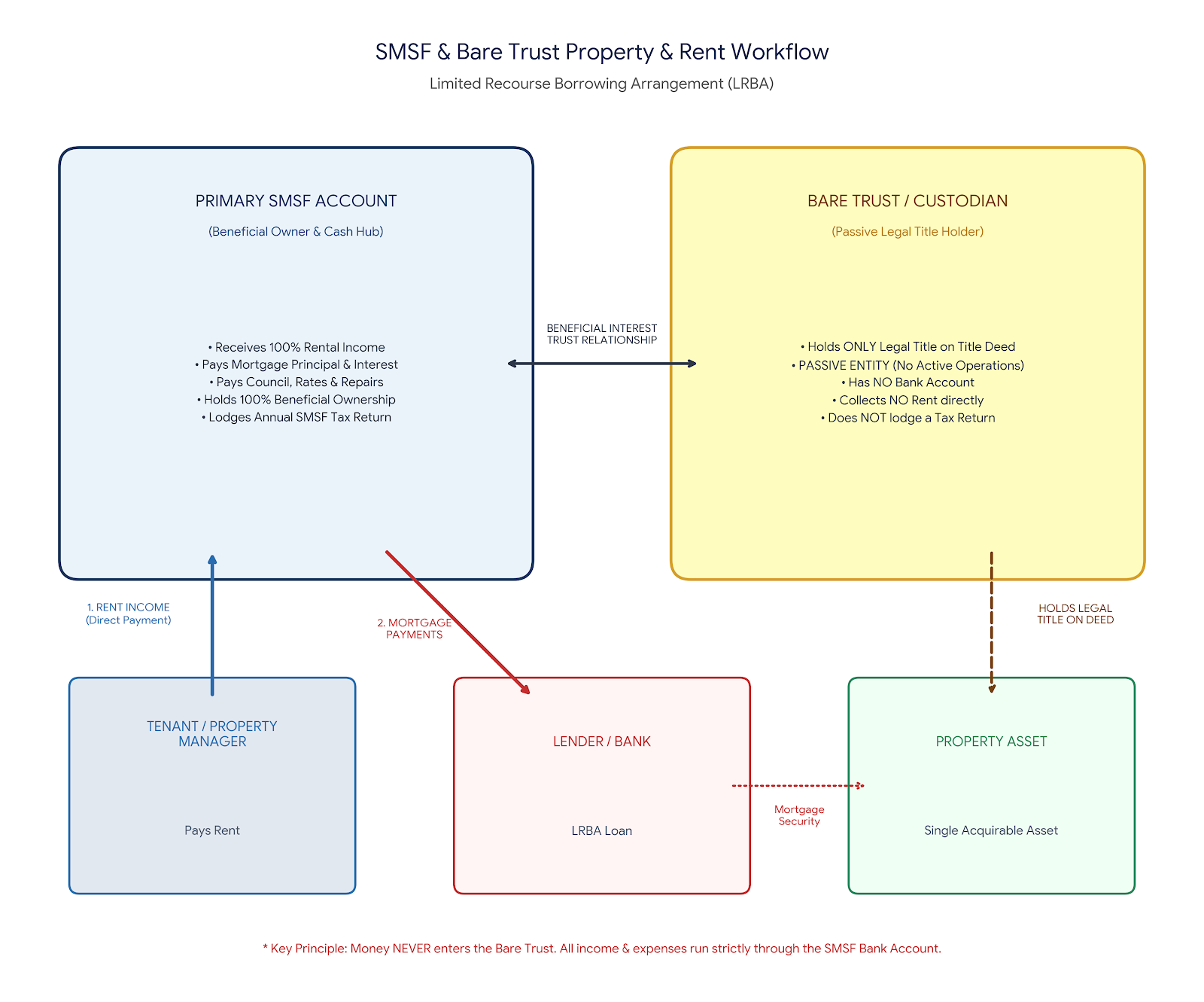
The 3-Phase Property Lifecycle
- Phase 1: Acquisition & Settlement
Your SMSF pays the deposit, stamp duty, conveyancing, and loan setup fees from its cash reserves. The lender supplies the remaining balance. Settlement completes, and legal title is registered under the Bare Trust (e.g., "Bare Trustee Pty Ltd as custodian for the SMSF").
- Phase 2: Ongoing Operations (Rent & Debt Servicing)
Your property manager or tenant deposits 100% of the rent directly into the Primary SMSF Bank Account. The SMSF uses rental income and member super contributions to pay loan repayments, council rates, insurance, and maintenance.
- Phase 3: Loan Discharge & Title Transfer
When the loan balance hits $0, the Bare Trust transfers legal title directly to the SMSF Trustee. The Bare Trust is dissolved, and the SMSF owns the property outright.
4. Key Legislative Rules: Residential vs. Commercial Real Estate
When planning a property acquisition inside super, it is vital to understand the legislative framework governing SMSF borrowing:
- Commercial & Business Real Property (BRP): SMSFs can continue to utilize LRBAs to purchase commercial offices, retail storefronts, industrial warehouses, and medical suites.
- The Business Real Property Strategy: Small business owners can purchase their operational commercial premises through an SMSF using an LRBA. Your operating business leases the building from your SMSF at market rates. The rent paid by your business is 100% tax-deductible as an operating expense, while your SMSF collects the rent in a 15% tax environment.
- Residential Real Estate Rules: Residential properties can be acquired outright with available fund cash, but specific borrowing restrictions apply under superannuation rules for new residential LRBA loan setups. Existing residential LRBAs established under prior rules remain fully grandfathered.
5. Tax Advantages of SMSF Property Ownership
Holding investment property inside a Self-Managed Super Fund provides structural tax benefits that individual personal ownership cannot match:
- Concessional Rental Tax: Net rental income received by an SMSF in the accumulation phase is taxed at a flat rate of just 15% (compared to personal marginal tax rates of up to 47%).
- Discounted Capital Gains Tax (CGT): If the SMSF holds the property for more than 12 months before selling, the fund receives a one-third CGT discount, reducing the effective CGT rate to 10%.
- Tax-Free Retirement Phase: Once members transition the SMSF into the retirement pension phase (after age 60), rental income and capital gains on a property sale are taxed at 0%.
- Deductible Expenses: Loan interest, building depreciation, property management fees, council rates, and maintenance costs are fully deductible against the fund's taxable income.
6. Frequently Asked Questions (FAQ)
Can I live in or rent a residential property owned by my SMSF?
No. Superannuation law enforces the "Sole Purpose Test" and strict related-party rules. Neither you, fellow fund members, nor any relatives can live in, rent, or use a residential property owned by your SMSF.
Can an SMSF use borrowed money to renovate or develop a property?
No. Under LRBA rules, you can use borrowed funds to perform standard repairs and maintenance (restoring an asset to its original condition). However, you cannot use borrowed funds to execute major improvements or structural alterations (such as subdividing land or adding a residential granny flat) while an active loan exists.
Can my SMSF use one LRBA loan to buy two properties on separate titles?
No. Section 67A requires an LRBA to apply to a "single acquirable asset." If an acquisition involves multiple separate titles (e.g., an apartment with a car park on a separate title that can be sold independently), separate LRBA loan structures must be established.
📚 Explore Related SMSF Property Guides (Cluster Content)
Deepen your knowledge of SMSF investing with our specialized accounting guides:
Take Control of Your Retirement Wealth
Setting up an SMSF property purchase requires absolute structural precision. At TENfold Wealth Accountants, our team manages borrowing capacity calculations, entity setups, contract reviews, and annual tax compliance.
Book a Strategy Consultation with TENfold Wealth Accountants