"At Tenfold, we don't just report the budget; we forecast the strategy. Plant the seed today to harvest tomorrow."
The 2026-27 Australian Federal Budget has introduced generational shifts in property taxation, trust compliance, and small business incentives. For property investors and SMEs, the "business as usual" approach ended at 7:30 PM tonight. This analysis dives deep into the technical changes to help you navigate the 2026-27 financial year with confidence.
Property Investment: The Supply-Driven Tax Era
The government's housing policy has shifted from broad-based incentives to a targeted "supply-first" model. The core objective is to push investor capital away from existing dwellings and into new construction. This creates a clear two-tier tax system for Australian real estate.
Negative Gearing & Salary Offsets
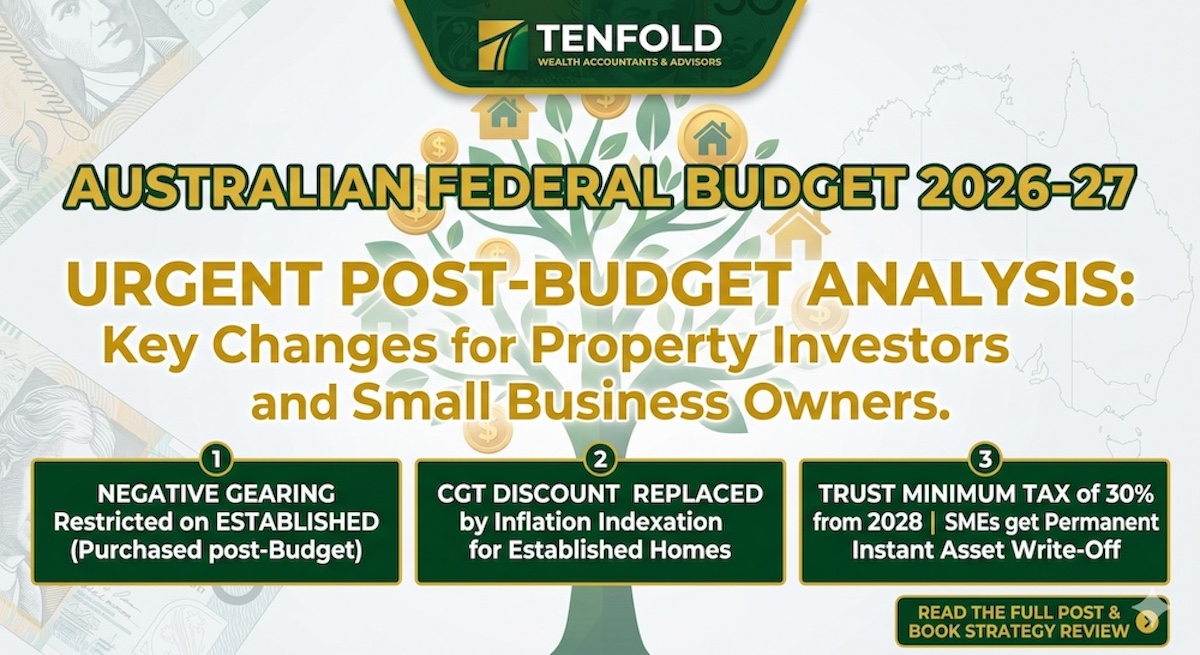
From 1 July 2027, the ability to offset residential rental losses against your salary and wages (negative gearing) will be restricted to New Builds only. For established properties purchased after tonight’s deadline, losses are "ring-fenced." This means you can still offset losses against other rental income or carry them forward to offset future capital gains, but you will no longer receive that immediate tax refund against your PAYG income.
CGT Indexation vs. The 50% Discount
In a return to pre-1999 policy, the 50% Capital Gains Tax (CGT) discount is being phased out for established dwellings in favor of Inflation Indexation. This ensures that investors only pay tax on "real" gains above CPI. While this protects long-term holders during high-inflation periods, it significantly increases the tax burden for short-to-medium term "flippers."
Strategic Arbitrage: Because New Builds retain the 50% CGT discount, they now represent a superior after-tax investment vehicle for high-growth portfolios.
Trusts & Wealth Structures: The 30% Floor
Perhaps the most significant change for high-net-worth families is the 30% Minimum Tax on Discretionary Trust distributions, effective 2028. Historically, trusts allowed families to distribute income to adult children or non-working spouses at lower marginal rates. This new "tax floor" effectively treats trusts more like companies, eliminating the benefit of distributing to anyone with a marginal rate below 30%.
SMSF Impacts: The Budget also confirmed the continuation of the Division 296 tax on super balances over $3M, but notably did not index the threshold. Wealthy Australians must now reconsider whether large balances in Super are more efficient than alternative structures like Investment Companies.
Small Business: Certainty Amidst Reform
While property investors face headwinds, small businesses have been granted much-needed certainty. The $20,000 Instant Asset Write-Off is now a permanent legislative fixture for businesses with an aggregate turnover of less than $10 million. This allows for immediate deductions on equipment, tech, and vehicles, rather than depreciating them over years.
Your Budget 2026 Action Plan
To ensure your strategy remains optimized, we recommend the following three-step checklist:
- Audit Purchase Dates: Ensure you have evidence (Exchange of Contract) for any property purchases made prior to 7:30 PM tonight to secure grandfathered status.
- Review Trust Deeds: Work with our team to model the impact of the 30% minimum tax and explore "bucket company" structures.
- Reassess Portfolio Mix: If you are planning an acquisition, the tax-alpha has shifted toward new builds and off-the-plan developments.
Is your strategy Budget-proof?
Don't let policy changes erode your portfolio. Secure a comprehensive Budget Strategy Review with Tenfold Wealth Accountants.
Book Your Review Now