
The landscape for rental property tax compliance in Australia has just shifted dramatically. For decades, property investors relied on long-standing tax rulings to claim deductions on holiday homes and short-term rentals (like Airbnb and Stayz).
That era is officially over.
The Australian Taxation Office (ATO) has completely overturned established practice by withdrawing the historic ruling IT 2167. In its place, the regulator has unleashed a powerful new compliance suite: Draft Taxation Ruling TR 2025/D1 and two highly targeted Practical Compliance Guidelines (PCG 2025/D6 and PCG 2025/D7).
The primary target? Mixed-use holiday homes and short-term rental properties. The ATO is moving away from simply counting the days a property was listed as “available for rent” and is now taking a holistic look at the property’s true, dominant purpose.
With the ATO’s 30 June 2026 transitional enforcement deadline fast approaching, here is a detailed breakdown of the new risk areas and how the team at Tenfold Wealth Accountants is moving to protect our clients.
1. The Core Weapon: The Section 26-50 “Leisure Facility” Trap
The most significant shift in TR 2025/D1 is the ATO’s aggressive application of Section 26-50 of the ITAA 1997 to residential holiday homes.
If the ATO determines that a holiday home or short-term rental is used—or held for use—mainly for private holidays or recreation by the owner, their family, or friends, the property will be legally classified as a “leisure facility.”
The Financial Danger: If your property falls into the leisure facility category, all deductions for ownership and holding costs are completely denied. This means you can no longer claim mortgage interest, council rates, land tax, building insurance, general maintenance, or capital allowance/tax depreciation. Earning a token amount of rental income is no longer a shield against this provision.
2. The ATO’s 3-Zone Risk Framework (PCG 2025/D7)
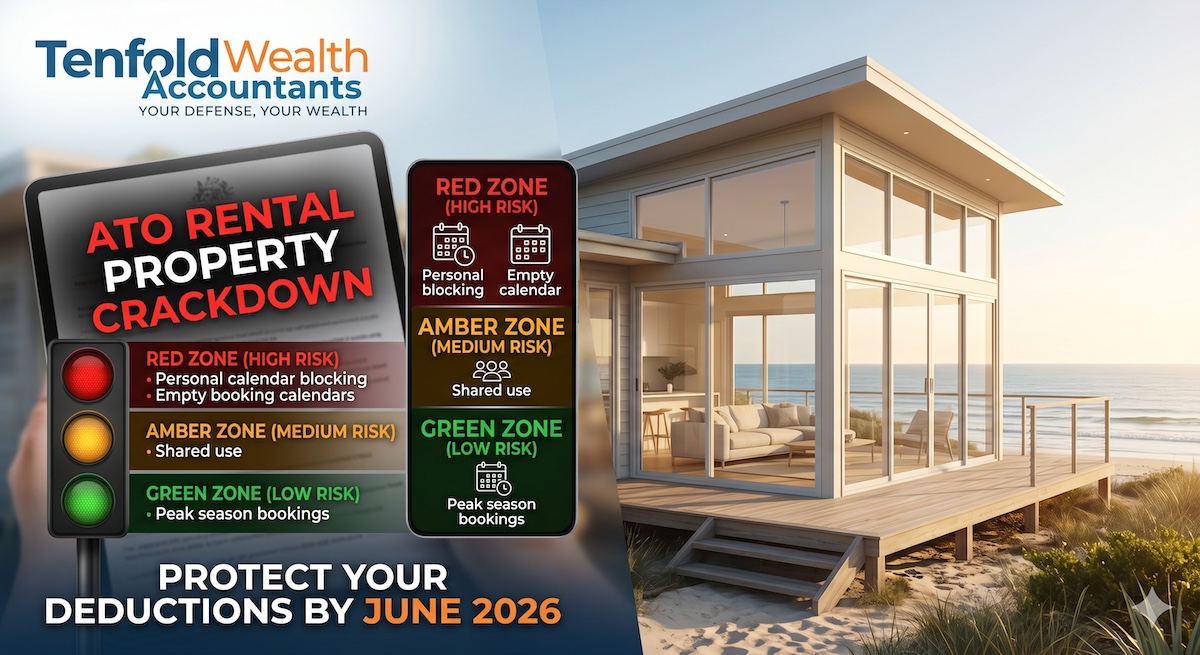
To decide which property owners will face an immediate, intensive audit, the ATO has introduced a traffic-light risk framework based heavily on occupancy patterns and owner behavior:
-
🟢 The Green Zone (Low Risk): Properties with high income-producing occupancy, particularly during peak holiday seasons (Christmas, Easter, and school holidays). These properties feature minimal personal use and are rented out on strict commercial terms with active efforts to maximize revenue. The ATO will generally not allocate resources to test the “leisure facility” definition here; standard apportionment rules apply.
-
🟡 The Amber Zone (Medium Risk): Properties showing increased personal use by the owner, family, or friends for little to no cost. This includes forgoing high-tariff rental periods to keep the property vacant for private use. This zone triggers secondary reviews, requiring the owner to heavily justify that the dominant purpose was wealth generation.
-
🔴 The Red Zone (High Risk): Properties where owners prioritize personal use by blocking out peak seasonal demand times, or where they set unreasonably high listing rates and strict booking terms to intentionally deter the public. It also includes properties where significant portions of the home are locked or inaccessible to guests. This is a high-audit zone where the ATO will actively seek to deny all holding cost deductions under Section 26-50.
3. Tightened Apportionment & Big Data Matching
Beyond the leisure facility rules, the ATO is tightening its grip on two other critical areas:
-
Non-Arm’s Length Bookings (PCG 2025/D6): If you rent your property to family or friends at discounted “mates’ rates,” the rules have tightened. Your expense deductions are now strictly capped at the actual amount of rental income received, completely eliminating the ability to manufacture a tax loss on the arrangement.
-
Unprecedented Data-Matching: The ATO is no longer operating on self-reporting guesswork. They are actively cross-matching data directly from short-term platform providers (Airbnb and Stayz), property management software, financial institutions (tracking loan redraws), and state land tax registries. They know exactly when your property was booked, by whom, and for how much.
4. How Tenfold Wealth Accountants Will Protect You
With the transitional enforcement window for pre-existing arrangements closing on 30 June 2026, proactive defense is vital. At Tenfold Wealth Accountants, we have already begun implementing a dedicated compliance protocol to insulate our clients from this crackdown.
Here is how our team will protect your portfolio:
-
We will conduct a Peak-Period Calendar Audit: Our team will meticulously review your booking histories across Airbnb and Stayz. If you have historically blocked out high-demand periods (like Christmas or school holidays) for personal use, we will help you restructure your calendar strategy to shift your property safely out of the Red and Amber risk zones before the ATO’s deadline.
-
We will verify your Commercial Pricing Strategies: To prevent the ATO from accusing you of setting artificially high rates to deter bookings, we will evaluate your listing prices against local market data. We ensure your pricing stands up to regulatory scrutiny as a genuine commercial endeavor.
-
We will implement Airtight Logbook Protocols: Loose estimations are an audit trigger. We provide our clients with clear frameworks to maintain strict, contemporaneous records. We will help you clearly document days actually rented, days genuinely available at market rates, and days used strictly for maintenance.
-
We will isolate and protect your Investment Loans: If your investment loan has been contaminated by private drawdowns or mixed purposes, a blanket denial of interest claims is a real threat. We will scrutinize your statements and apply exact, sub-account mathematical apportionment to safeguard your legitimate interest deductions.
-
We will map your Capital Gains Tax (CGT) Exposure: If you are renting out a portion of your primary home or navigating temporary short-stay conversions, we will precisely calculate how your Main Residence CGT exemption is impacted, ensuring there are no multi-thousand-dollar surprises when you eventually decide to sell.
Use Tenfold’s Holiday Home & Short-Term Rental Digital Compliance Logbook
Should you choose to engage Tenfold Wealth as your Airbnb accountant, you will be allowed access to the “Holiday Home & Short-Term Rental Digital Compliance Logbook“. This logbook will protect you against ATO Audits.
Time is of the Essence
The ATO has made it clear that the short-term rental market is one of their highest compliance priorities. With the transitional period ending on 30 June 2026, the time to review your property arrangements is right now.
If you own a short-term rental or a family holiday home, don’t wait for an audit letter to arrive. Contact an Airbnb accounting specialist at Tenfold Wealth Accountants today to review your position and secure your property deductions.
Disclaimer: This article contains general information only and does not constitute personal financial or tax advice. For advice tailored to your specific circumstances, please book a consultation with Tenfold Wealth Accountants.
